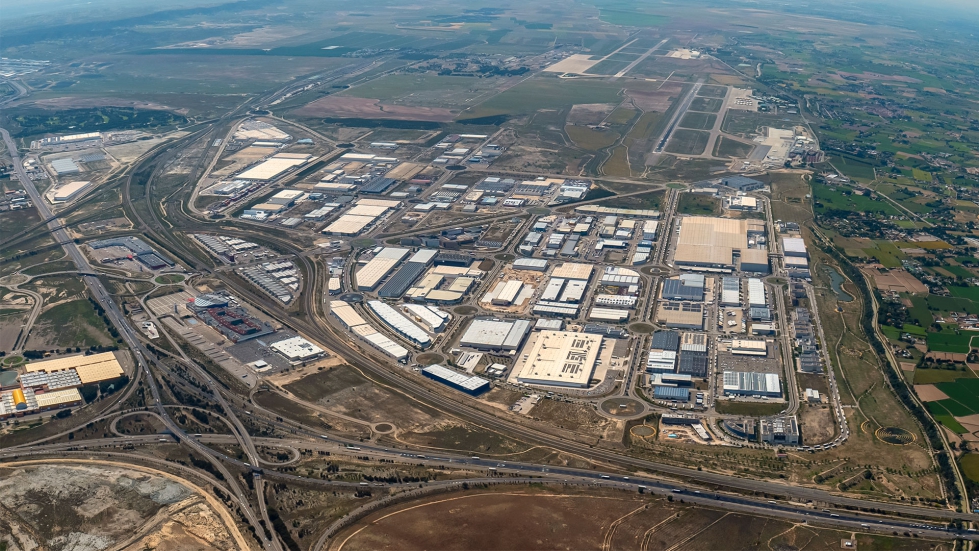
01. THE CLOUD WAS NEVER IN THE CLOUD
For decades, the expansion of digital technologies has been accompanied by an imaginary of dematerialization. Information circulates, is stored, and is processed in a cloud seemingly detached from geography. The digital economy appears to operate in a borderless space, where distance loses its significance and physical infrastructures disappear behind interfaces.
Yet the cloud was never in the cloud. Its operation depends on buildings, transmission networks, electrical systems, cooling facilities, fiber-optic connections, land, water, and energy. Behind every digital operation lies a material infrastructure that occupies and transforms territory.
In Aragon, Spain, the expansion of large data centers promoted by international technology companies is shaping a new productive geography. Investments announced by companies such as Amazon and Microsoft involve more than constructing buildings for storing and processing information. They entail new demands for energy, connection infrastructure, water resources, land, and territorial planning decisions.
The location of these facilities responds to specific conditions: energy availability, connectivity, land, regulatory frameworks, and opportunities for expansion.
What is often presented as a technological investment is also a territorial operation.
Aragon allows us to observe a contemporary phenomenon which, although associated with recent technologies, belongs to a much longer history: the ability of major economic activities to reorganize entire geographies around their productive needs.
The question, then, is not only how many data centers will be built or what economic benefits they will generate.
It is what kind of territory they are beginning to construct.
02. COMPANIES HAVE ALWAYS PRODUCED TERRITORY
The production of territory by large companies is not exclusive to the digital economy.
During the nineteenth and twentieth centuries, mining, steel, railway, oil, and energy companies directly participated in the transformation of entire regions. Their operations required infrastructure, settlements, transport networks, hydraulic systems, and new forms of organizing work and space.
Productive activities did not simply settle in preexisting territories. In many cases, they helped construct them.
Industrial infrastructure was not merely a consequence of economic growth. It was one of its principal conditions of possibility.
Railways, ports, canals, power stations, dams, and supply systems connected natural resources, production facilities, markets, and populations. Over time, these relationships shaped territorial structures that extended beyond individual installations.
Germany's Ruhr region is one of the most significant examples of this process.
Its industrial development was linked to coal extraction, steel production, and the construction of extensive energy, railway, and hydraulic infrastructure networks. Industry transformed the landscape and helped produce one of Europe's major urban and productive regions.
But it also created dependencies.
The economic specialization of extensive territories around particular activities produced forms of spatial organization that were difficult to change when productive conditions began to shift.
This historical relationship allows us to see Aragon from another perspective.
Today's technology companies do not reproduce the material conditions of heavy industry, but they participate in a comparable territorial logic: they concentrate investment, demand specific infrastructure, and can influence regional planning and development priorities.
Economies change. Technologies change.
The capacity of productive activities to organize territory remains.
03. WATER AND THE CONSTRUCTION OF INDUSTRIAL TERRITORY
The industrial history of the Ruhr cannot be understood solely through its mines, factories, and railways.
It is also the history of a profound transformation of its water systems.
The Rhine, Ruhr, and Emscher rivers, together with numerous tributaries, canals, and artificial systems, formed part of a territorial infrastructure that sustained industrial and urban growth.
Water was used for supply, production, transport, and waste disposal. Its management required hydraulic interventions that altered river courses, ecological relationships, and territorial dynamics.
The Emscher is a particularly revealing case. For much of its industrial history, the river and its tributaries were transformed to serve drainage and wastewater disposal functions.
Industrialization did not merely occupy the landscape: it modified its processes.
As certain industrial activities declined, these systems began to acquire a different meaning.
The restoration of the Emscher involved a regional intervention spanning several decades: the construction of sanitation infrastructure, the separation of wastewater, the progressive restoration of river channels, and the recovery of spaces associated with the river system.
What had previously been transformed to enable industrial production began to be reworked to restore environmental and territorial capacities.
Water ceased to be understood exclusively as an industrial resource or support and became a structuring element of the region's transformation.
This reversal of functions is fundamental.
Industrialization transformed water systems to make an economy possible. Territorial regeneration transforms those systems once again to make other futures possible.
04. WHEN THE ECONOMY CHANGES AND THE TERRITORY REMAINS
During an academic journey through Germany's industrial landscapes in 2008–2009, it was possible to observe firsthand some of the contradictions produced by the transformation of European industrial economies.
Large abandoned facilities, extensive degraded areas, oversized infrastructure, and territories struggling to redefine their relationship with declining productive activities.
The study of shrinking cities—cities affected by population loss, aging, and economic contraction—made it possible to recognize that industrial decline is not expressed solely through abandoned buildings.
Its consequences extend to urban systems, services, infrastructure, land occupation, and relationships between population and territory.
These processes were not homogeneous. The shrinking cities of eastern Germany and the transformations of the Ruhr responded to different economic, political, and demographic histories.
Nevertheless, both contexts revealed a shared condition: spatial structures produced by particular economic cycles can persist long after their original functions have weakened or disappeared.
Industrial facilities could cease operating. Railway tracks, contaminated land, settlements, hydraulic networks, and major topographic alterations continued to form part of the territory.
Economic transformation did not erase its material consequences.
Economies have cycles. Territories accumulate their consequences.
This difference between economic time and territorial time is one of the central problems of regeneration.
A company can modify its operations, abandon facilities, or relocate investments. Territory, by contrast, retains the transformations made to its geography.
05. FROM THE INDUSTRIAL OBJECT TO THE RECOVERED LANDSCAPE
German industrial regeneration projects explored different possibilities for transforming inherited structures.
At Landschaftspark Duisburg-Nord, former steelworks facilities were incorporated into a public park through new recreational, cultural, and landscape activities. A former gasometer, for example, was adapted for scuba diving.
At Zollverein, facilities associated with coal extraction and processing acquired new cultural and heritage functions.
These interventions demonstrated that industrial infrastructure could be preserved and given new meanings.
Yet they also raised a contradiction.
The enormous built areas created to sustain intensive productive systems could hardly find a direct equivalent in new cultural, commercial, or recreational programs.
A furnace could become an exhibition space. A storage tank could accommodate sporting activities. A factory could be adapted into offices.
But how many programs of this kind would be needed to occupy and sustain extensive industrial territories?
Architectural reuse alone did not guarantee territorial regeneration.
The deeper dimension of these experiences emerged when attention shifted from rehabilitated objects to the landscape systems that contained them.
Soil remediation, the restoration of ecological corridors, the articulation of open spaces, and the transformation of river systems offered possibilities extending beyond the specific programs of individual buildings.
In this sense, Emscher Landschaftspark acquired a meaning different from that of a collection of architectural interventions.
Its significance lay in constructing a regional landscape structure capable of connecting industrial spaces, ecological systems, urban areas, and infrastructure.
The value of regeneration did not depend exclusively on preserving structures from the past, but on recovering territorial capacities for the future.
An infrastructure can recover its architectural usefulness without recovering its capacity to structure a territory.
The rehabilitation of an object can form part of a broader strategy. But it should not replace it.
06. RECONSTRUCTING A GEOGRAPHY: MINING, WATER, AND THE LONG TERM
The German experience allows us to take this reflection to an even larger scale.
In the Rhenish mining basin, open-cast lignite extraction radically transformed topography, water systems, and the spatial relationships of extensive areas.
The scale of these excavations reveals an extreme condition of territorial production: geography itself becomes infrastructure.
During that academic journey, a visit to one of these large mining operations made it possible to witness the physical magnitude of the transformation firsthand. The extraction terraces, monumental machinery, and depth of the excavation revealed a scale of intervention difficult to comprehend through plans or photographs.
In these landscapes, regeneration cannot be limited to preserving buildings or introducing new activities.
It must confront changes in topography, ground stability, altered aquifers, and the environmental consequences of extraction.
Projects to create lakes in former mining pits represent a large-scale territorial response. Through controlled flooding, hydrological management, and environmental restoration, they propose transforming excavations into new landscape systems.
This is not simply a matter of introducing water into an abandoned mine. Water quality, slope stability, water availability, and the presence of contaminants require technical interventions and monitoring over long periods.
Nor does it necessarily mean recovering a previous natural condition.
In many cases, extraction has irreversibly modified the original geography.
The project therefore consists of constructing new environmental and spatial conditions upon a profoundly transformed territory.
Recovery becomes an operation that may extend across generations.
And here a dimension frequently absent from architectural debate emerges: the need for institutions capable of sustaining transformation beyond the lifespan of each project.
The German experience offers different mechanisms for regional coordination, environmental management, and financing obligations inherited from industrial activity.
IBA Emscher Park coordinated urban, landscape, and industrial regeneration projects within a regional strategy. Other institutions have assumed responsibilities related to mine rehabilitation, water management, and the enduring consequences of extraction.
These instruments are not equivalent, but they reveal a shared principle.
Territorial regeneration requires institutional continuity.
It is not enough to design a future landscape. The mechanisms that make it possible and sustain it over time must also be constructed.
When productive transformation reaches the scale of geography, responsibility for its consequences must likewise acquire a territorial and long-term dimension.
07. SHOUGANG AND ARAGON: BETWEEN INDUSTRIAL REGENERATION AND A NEW DIGITAL GEOGRAPHY
The transformation of the former Shougang steelworks in western Beijing introduces another experience into this history.
Unlike Germany's regional mining landscapes, Shougang involves the transformation of a large industrial complex integrated into the metropolitan restructuring of a capital city.
During its rehabilitation, former steelmaking structures began to be adapted for new activities, while remediation work was carried out on soils affected by industrial activity.
Furnaces, silos, and other inherited facilities became part of a process of architectural and urban reprogramming.
The complex subsequently incorporated new cultural, commercial, workplace, and sports functions, including facilities associated with the Beijing 2022 Winter Olympic Games.
The transformation produced a new image of the industrial landscape.
Structures that had previously represented the city's productive capacity began to be incorporated into a narrative of modernization, heritage, and urban renewal.
But Shougang also reveals the distance between the image of regeneration and its actual territorial performance.
Introducing new programs does not, by itself, demonstrate that a former industrial structure has found a new economy capable of sustaining it over the long term.
Regeneration must also be evaluated through its environmental outcomes, urban integration, accessibility, management arrangements, and capacity to accommodate further transformations.
The case shows that recovering an industrial landscape is not merely a material operation.
It is also an intervention in the city's imaginaries and in the decisions that determine which elements of the past should be preserved and which future is to be represented.
In Aragon, the situation is different.
There, we are not primarily observing the regeneration of inherited infrastructure, but the construction of a new generation of productive facilities.
Data centers do not share the same material characteristics as mines or steelworks. Their technologies, impacts, renewal cycles, and possibilities for adaptation are different.
Yet historical experiences allow us to formulate questions that should accompany their development from the outset.
What energy and water dependencies are they creating?
What infrastructure will need to remain in place to sustain their operation?
How adaptable will these facilities be when technologies change?
What environmental and territorial obligations will companies assume during their operation and afterward?
And which institutions will have the capacity to manage those consequences?
The point is not to predict that Aragon will repeat the history of the Ruhr, the Rhenish mining basin, or Shougang.
It is to recognize that decisions made while constructing infrastructure shape the future possibilities of the territory.
08. THE LONG DURATION OF THE CLOUD
The expansion of digital infrastructure is usually interpreted through the speed of technological innovation.
New processing systems, greater storage capacities, automation, and the growth of artificial intelligence reinforce the idea of continuous economic transformation.
Yet the material infrastructures sustaining these activities belong to different timescales.
Buildings, electrical networks, hydraulic systems, transmission corridors, and transformations of the land may endure far longer than the technologies that justified their construction.
This difference requires us to reconsider how we design productive territories.
The experience of European industrial landscapes demonstrates that regeneration cannot be reduced to finding new functions for obsolete structures.
Architectural programs can change. Economic activities can disappear. Even the imaginaries of modernity that once justified particular investments can lose their relevance.
But remediated land, a restored river system, a reconstructed ecological continuity, or adaptable territorial infrastructure can sustain possibilities we do not yet know.
Their persistence is not automatic. It depends on maintenance, management, and collective decisions. This is precisely why the institutional dimension forms part of the landscape project.
The central problem is not ensuring that every building remains occupied indefinitely.
It is preventing the disappearance of an economic activity from leaving behind a territory incapable of supporting other forms of life and production.
From this perspective, landscape acquires an operative condition.
It is not merely the image resulting from economic transformation, nor the setting in which new infrastructure is installed.
It is a system of environmental, spatial, social, and institutional relationships whose capacities can be damaged, preserved, recovered, or expanded through design.
Aragon allows us to observe these decisions while they are still being made.
And that condition is fundamental.
Unlike industrial territories now struggling to manage the consequences of previous economic cycles, digital infrastructure offers an opportunity to incorporate questions of adaptation, environmental responsibility, and territorial futures from the outset.
We do not know which technologies will dominate fifty or a hundred years from now.
Nor can we predict with certainty which facilities will continue operating, which will need to be transformed, or what new activities will emerge.
But we can recognize that today's territorial decisions will shape those possibilities.
The objective should not simply be to extend the life of infrastructure, but to expand the possibilities for life in the territory that contains it.
The cloud needs territory.
And that territory will still exist when the cloud has changed.
The question that remains is:
Who assumes responsibility for the territory when the economy that transformed it no longer needs it?
And, more importantly:
Can we build the infrastructures of the present without compromising the territorial capacities that future generations will need?